
It’s 10 AM. You just ate breakfast two hours ago, but you’re already thinking about snacks. Your stomach feels… something. Not quite empty, but unsettled. You’re drawn to the pantry.
Or it’s 3 PM. You had lunch, but now you’re craving something—anything. Maybe chips. Maybe something sweet. Your energy is dipping and food feels like the answer.
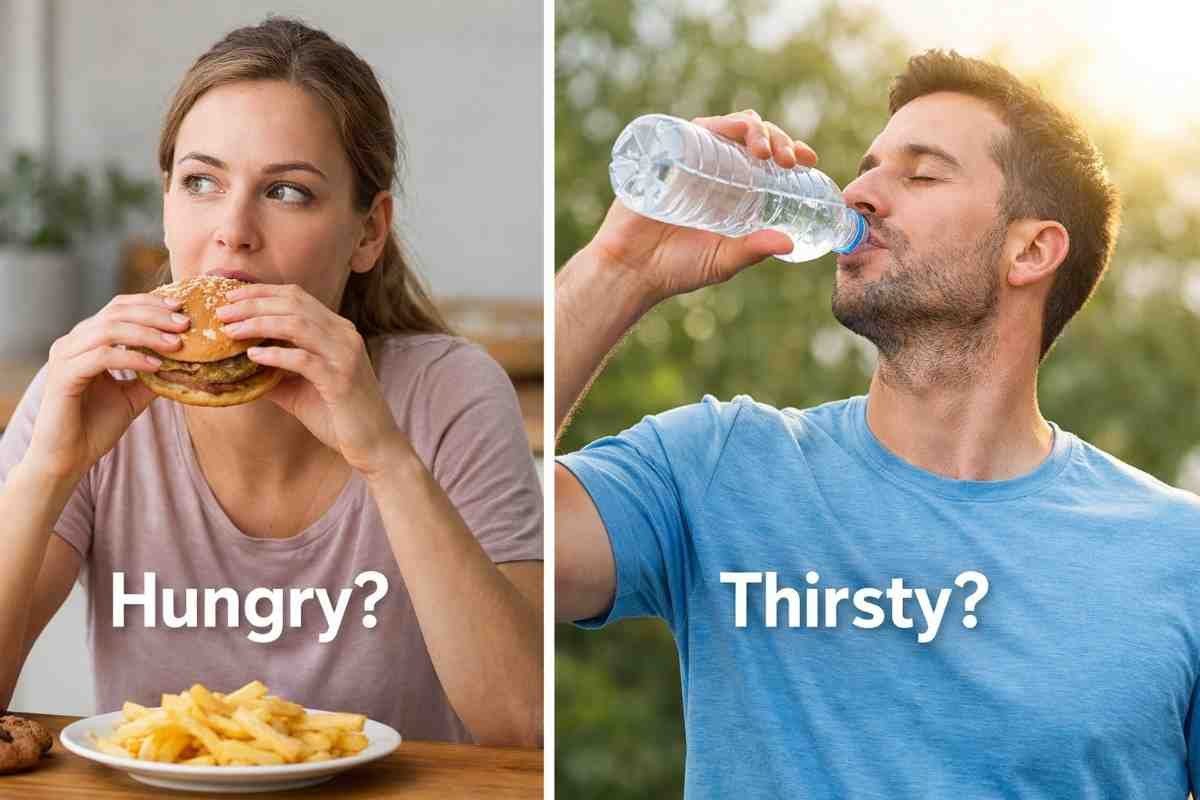
Here’s the question almost nobody asks: Are you actually hungry, or is your body desperately trying to tell you something else?
Research reveals a startling truth: In one study, individuals responded appropriately by drinking water when they were thirsty but not hungry only 2 percent of the time, while they responded inappropriately 62 percent of the time.
That means 62% of the time we reach for food when we should be reaching for water.
Let me show you exactly why this happens, how to tell the difference, and the stupidly simple test that stops unnecessary snacking while boosting your energy naturally.
The Brain’s Confusion: Why Hunger and Thirst Feel Identical
The same part of your brain—the hypothalamus—is responsible for interpreting both hunger and thirst signals, which can often result in mixed messages. This tiny region acts as a bridge between your nervous system and endocrine system, regulating hormones, controlling body temperature, and generating sensations of both hunger and thirst.
The problem? These signals traveling to your brain are remarkably subtle. When you’re only mildly dehydrated (which most people are throughout the day), your brain can easily misinterpret the signal.
Why Dehydration Masquerades as Hunger
When you’re even mildly dehydrated, the hypothalamus can misinterpret thirst cues as hunger, making you reach for a snack when what your body really needs is fluids.
Here’s the cascade that happens:
- Your body becomes even slightly dehydrated (1-2% fluid loss)
- The hypothalamus detects this
- It sends a signal: “We need something”
- Your brain interprets this as “need energy”
- You experience it as hunger
- You eat when you should drink
This isn’t a design flaw—it’s actually your body being extremely clever. While life-threatening health consequences of inadequate food intake are not manifest for weeks to months, allowing behavioral responses to hunger to be deferred for extended periods, for water the time frame is reduced to days, so thirst is a particularly salient signal.
Your body prioritizes hydration over calorie intake because you can survive weeks without food but only days without water. So when it needs water urgently, it creates a strong “consume something” signal—even if you interpret it as hunger.
The Symptoms That Overlap: Why You Can’t Tell the Difference
Here’s where it gets tricky. Some symptoms of mild dehydration—headache, fatigue, lightheadedness and difficulty concentrating—can resemble symptoms of hunger.
Let me break down what each actually feels like:
Dehydration Signals Often Mistaken for Hunger:
- Headache or slight head pressure
- Fatigue and sluggishness
- Difficulty concentrating or brain fog
- Lightheadedness
- Irritability
- A general sensation of “I need something”
- Stomach discomfort or mild nausea
- Dry mouth (though you might not notice it)
True Hunger Signals:
- Gradual onset (builds over time since last meal)
- Stomach growling or rumbling
- Slight shakiness
- A distinct sensation of emptiness in your stomach
- Willingness to eat almost anything (not specific cravings)
- Occurs 3-4 hours after your last substantial meal
Open-ended questionnaires indicate that study participants experience a wide range of sensations that they collectively refer to as hunger, including sensations directly related to the stomach, head, more generalized sensations, and attributions to other sensory systems such as those related to fluid balance.
The overlap is so significant that your body is literally using some of the same signaling mechanisms for both needs.
The Hidden Cost of Mistaking Thirst for Hunger
This constant confusion doesn’t just lead to one extra snack. It creates a pattern that compounds over time.
The Weight Gain Connection
Research found that among adults, poor hydration was associated with higher body mass index (BMI), with researchers speculating that individuals classified as obese may have a harder time staying hydrated and may be more likely to eat when they are actually thirsty.
Here’s the math that nobody talks about: If you eat a 200-calorie snack when you’re actually thirsty (not hungry), and this happens just once daily, that’s 1,400 extra calories per week—enough to gain nearly half a pound. Over a year? That’s 20+ pounds from misread signals alone.
The Energy Drain
When you’re dehydrated, eating doesn’t fix the underlying problem. Your body still needs water. So:
- You eat, feel temporarily better (placebo effect)
- But within 30-60 minutes, the fatigue returns
- Your brain still struggles to focus
- You feel sluggish despite having consumed calories
- You reach for more food or caffeine
- The cycle continues
Dehydration doesn’t just affect your body physically; it can take a toll on your mental state as well, with people finding themselves feeling fatigued, struggling to focus, or even experiencing a headache when thirsty.
Meanwhile, your body keeps screaming for the one thing it actually needs: water.
The Stupidly Simple Water Test
Here’s the test that changes everything. It takes 10 minutes and costs nothing.
The Water Test Protocol
Step 1: The moment you feel “hungry” between meals, stop.
Step 2: Drink a large glass of water—8 ounces minimum—and wait about 15 minutes.
Step 3: Check in with yourself.
- If the hunger is completely gone → You were dehydrated
- If you feel significantly better but mild hunger remains → You were mostly dehydrated, possibly slightly hungry
- If the hunger is unchanged or stronger → You’re genuinely hungry
That’s it. This simple test tells you exactly what your body actually needs.
Why 10-15 Minutes Matters
When you are dehydrated you may gulp down water for several seconds and you feel satisfied; however, at that point your blood is not rehydrated yet as it usually takes about 10 to 15 minutes.
Your body needs time to:
- Absorb the water from your stomach
- Distribute it through your bloodstream
- Rehydrate your cells
- Signal your brain that hydration is restored
Waiting those 10-15 minutes allows the actual physiological response to occur—not just the sensation of drinking something.
How to Actually Tell If You’re Hungry (Not Just Craving or Thirsty)
Beyond the water test, here are additional ways to distinguish genuine hunger from other signals:
The Timing Test
You should be eating every 3-4 hours, so if you’re eating more regularly than this, it may mean you’re not actually hungry.
Ask yourself: How long has it been since I last ate a substantial meal?
- Less than 2-3 hours → Probably not genuine hunger
- 3-4 hours → Could be hunger
- 5+ hours → Likely genuine hunger
The Apple Test
This is brilliantly simple. Ask yourself: Would I be willing to eat an apple now? If you’re hungry, you’ll probably be happy to eat an apple.
True hunger means you’re willing to eat nutritious, simple food—not just specific cravings. If only cookies or chips sound appealing, you’re likely dealing with:
- Dehydration
- Boredom
- Emotional eating
- Habit
- Blood sugar crashes (from earlier poor food choices)
Not actual hunger.
The Gradual Onset Principle
True physical hunger builds gradually. It doesn’t hit you suddenly out of nowhere.
Sudden “hunger” that feels urgent? That’s usually:
- Blood sugar crash (from eating too many simple carbs earlier)
- Dehydration
- Stress response
- Habitual eating triggers
Why Most People Are Chronically Mildly Dehydrated
Here’s the uncomfortable truth: 70% of people fail to drink enough water, resulting in dehydration.
And here’s why it’s so common:
The Thirst Mechanism Is Delayed
By the time you’re thirsty, you’re probably already dehydrated. Waiting until you feel thirsty to drink water means you’ve already been operating in a dehydrated state—possibly for hours.
Coffee Doesn’t Count
If your daily liquid intake begins primarily with coffee, by the time you feel thirsty you may already be dehydrated, as dehydration symptoms include dry eyes, headache, sluggishness, nausea, and dizziness.
Caffeine is a mild diuretic, meaning it increases urination. While the water in coffee does contribute to hydration, the net effect when consumed in large quantities throughout the morning can leave you more dehydrated by midday.
We’ve Lost Touch With Our Body’s Signals
Modern life trains us to ignore body signals:
- We’re too busy to stop for water
- We mistake thirst for hunger (and eat instead)
- We override thirst with coffee or energy drinks
- We’ve developed habits that disconnect us from natural cues
The Signs You’re Dehydrated Right Now
Check for these indicators:
Urine Color: If you are drinking enough water, your urine should be very pale yellow; it’s darker when you’re dehydrated. This is the simplest, most reliable indicator.
Physical Signs:
- Dry mouth (even slightly)
- Headache or head pressure
- Fatigue despite adequate sleep
- Difficulty concentrating
- Dizziness when standing up
- Dark circles under eyes
Behavioral Patterns:
- Reaching for snacks frequently throughout the day
- Craving sugar or salt
- Feeling hungry shortly after eating
- Needing excessive caffeine to function
What to Do: The Hydration-First Protocol
Here’s the practical system that stops unnecessary snacking and boosts consistent energy:
Morning: Set Your Hydration Baseline
Start your day with water BEFORE caffeine. Drink at least 500 ml of water after waking up.
Why this matters: You’ve been fasting for 8+ hours. Your body is naturally dehydrated upon waking. Reaching for coffee first compounds this.
Throughout the Day: Hydrate Proactively
Drink water at regular intervals throughout the day, even if you don’t feel thirsty, and you’ll have less of a chance of becoming dehydrated.
The baseline: Aim for 8-10 cups (64-80 oz) of water daily—more if you:
- Exercise
- Are in hot/dry climates
- Consume caffeine or alcohol
- Are larger in body size
- Are pregnant or breastfeeding
Before Every Snack: The Mandatory Water Test
Make this non-negotiable: Before eating anything between meals, drink 8 oz of water and wait 10 minutes.
This single habit can:
- Eliminate 50-70% of unnecessary snacking
- Save hundreds of calories daily
- Improve energy and focus
- Help you lose weight without “dieting”
- Fix chronic afternoon energy crashes
Bonus: Hydrate BEFORE Meals
Drink before every meal; research suggests it can be helpful to drink a tall glass of water before your meal.
This improves digestion, prevents overeating, and ensures you’re distinguishing hunger from thirst before consuming a full meal.
How to Make This Actually Work in Real Life
Knowing what to do doesn’t help if you don’t actually do it. Here’s how to make hydration automatic:
Strategy 1: Keep Water Within Arm’s Reach
Carry a water bottle—always keep hydration within arm’s reach.
Make it impossible to forget. Have water bottles:
- At your desk
- In your car
- In your bag
- Next to where you sit at home
The easier it is, the more you’ll drink.
Strategy 2: Create Hydration Triggers
Link drinking water to existing habits:
- Wake up → Drink 16 oz water
- Sit down at desk → Drink water
- Before every meal → Drink water
- Feel hungry → Water test (drink, wait 10 minutes)
- Before bed → Drink water
Strategy 3: Make It More Appealing
If you find water boring:
- Add lemon, lime, cucumber, or berries
- Try sparkling water
- Use an insulated bottle to keep it cold
- Set a goal or use a tracking app
Whatever makes you actually drink more water is the right approach.
When Eating IS the Right Answer
The water test isn’t about never snacking. It’s about eating when you’re actually hungry.
After the water test, if you’re genuinely hungry:
Choose foods that satisfy hunger AND provide hydration:
- Fresh fruits (watermelon, oranges, berries)
- Raw vegetables (cucumber, celery, tomatoes)
- Greek yogurt
- Soup or broth
- Whole foods with high water content
These satisfy both hunger and contribute to hydration—a two-for-one benefit.
How Medhya AI Helps You Decode Hunger vs. Thirst Signals
Understanding the water test is step one. But here’s where personalization becomes powerful:
Your hydration needs and hunger signals change based on:
- What you ate earlier (certain meals increase thirst)
- Your activity level today
- Your stress levels (stress increases both hunger and thirst signals)
- Where you are in your cycle (hormones affect fluid retention and appetite)
- How you slept (poor sleep increases hunger hormones)
- Environmental factors (temperature, humidity, altitude)
Medhya AI tracks these patterns for you:
When you log “feeling hungry between meals,” Medhya AI considers:
- Time since last meal
- Composition of last meal (high-sodium or high-carb meals increase thirst)
- Your typical eating schedule
- Your hydration patterns this week
- Your energy levels
- Your stress indicators
- Your sleep quality
Then provides specific guidance:
“You report feeling hungry 2 hours after lunch. However, your lunch was relatively high in sodium and you’ve logged minimal water intake today. This is likely thirst, not hunger. Try this:
- Drink 12-16 oz of water now
- Wait 15 minutes
- Check in: If hunger persists, have a small snack with protein + water-rich foods (apple with almond butter, cucumber with hummus)
- Goal for rest of day: 40+ more oz of water
Pattern alert: You’ve reported between-meal hunger 5 of the last 7 days. Your water intake averages only 32 oz daily. Increasing to 64 oz will likely eliminate 70% of these cravings.”
This isn’t guessing. This is precise pattern recognition showing you exactly what YOUR body needs.
The Bottom Line: Stop Eating When You Should Be Drinking
If you experience:
- Frequent snacking despite regular meals
- Afternoon energy crashes
- Constant low-level hunger
- Difficulty concentrating
- Headaches
- Weight that won’t budge despite eating well
The problem might not be what you’re eating. It might be what you’re NOT drinking.
The simple solution:
- Before eating anything between meals, drink 8-10 oz of water
- Wait 10-15 minutes
- Check in with how you feel
- If hunger persists, eat
This single habit can eliminate hundreds of unnecessary calories daily, improve your energy dramatically, enhance mental clarity, and help you finally distinguish between your body’s signals.
Stop snacking when you should be hydrating. Your body—and your waistline—will thank you.
Frequently Asked Questions
Q: Can drinking too much water be harmful?
Yes, but it’s rare. Water intoxication occurs when you drink excessive amounts (multiple gallons) in a short time, diluting blood sodium. For most people, 64-100 oz daily is safe and beneficial. Listen to your body and spread intake throughout the day.
Q: Do beverages other than water count toward hydration?
Yes—coffee, tea, milk, and other beverages contribute to hydration. However, some (like coffee and alcohol) have diuretic effects. Water remains the most efficient, zero-calorie hydration source.
Q: What if I’m still hungry after the water test?
Then you’re genuinely hungry—eat! The water test isn’t about restricting food. It’s about distinguishing true hunger from dehydration so you eat when your body actually needs calories, not when it needs water.
Q: How long does it take to retrain my body to recognize thirst properly?
Most people notice significant improvement within 7-10 days of consistent hydration. Once you regularly drink adequate water, your body’s thirst signals become clearer and you naturally stop confusing them with hunger.
Q: Why do I crave salty foods when I’m thirsty?
Your body is trying to retain water by increasing sodium. Paradoxically, eating salty foods when dehydrated can worsen dehydration. Drink water first, then assess if you still want salty foods.
Q: Can chronic dehydration cause weight gain?
Yes—directly and indirectly. Research links poor hydration to higher BMI. Dehydration slows metabolism, increases hunger signals, causes you to eat when you should drink, reduces exercise performance, and impairs digestion.
Leave a Reply