
Have you been trying to lose the same weight for years? Doing everything “right”—eating less, exercising more, following every diet—only to gain more weight, plateau endlessly, or feel increasingly exhausted?
You’re not alone. And more importantly: You’re not broken.
Research confirms what many people experience: obese individuals with nonalcoholic fatty liver disease were less likely to achieve five percent loss of body weight at three months on a very-low-calorie diet compared to obese counterparts without NAFLD.
The problem isn’t your willpower, dedication, or effort. The problem is that your metabolism has multiple systems locked down in protection mode—and until you unlock them, weight loss becomes not just difficult, but physiologically impossible.
The Weight Loss Trap Nobody Talks About
Here’s what nobody tells you about weight loss: Your body doesn’t care about fitting into your jeans. It cares about survival.
And when your metabolism is broken—when your liver is fatty, your insulin resistance is severe, your thyroid hormone can’t reach your cells, your gut is inflamed—losing weight becomes a THREAT to your survival.
Your body actively resists weight loss because releasing stored fat would flood already-overwhelmed systems with toxins, worsen inflammation, and potentially cause metabolic crisis.
This isn’t stubbornness. It’s intelligent self-preservation.
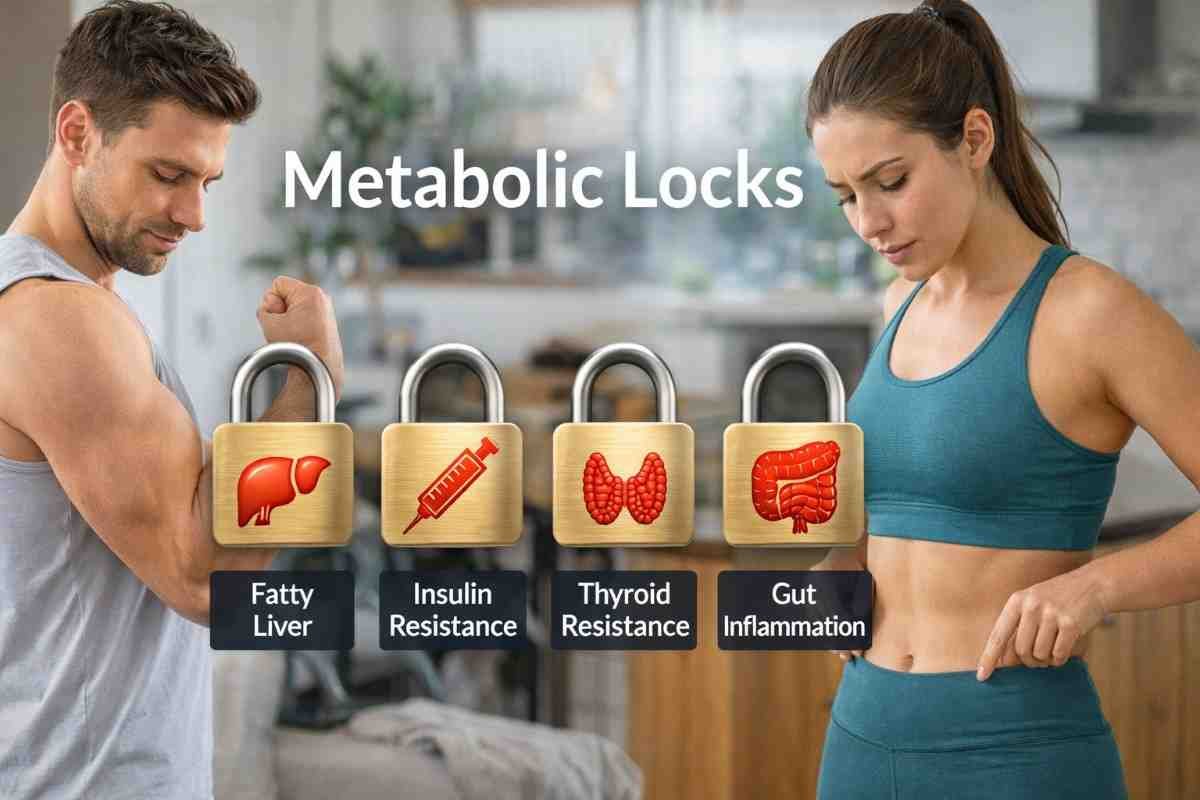
The Four Metabolic Locks That Prevent Weight Loss
When you can’t lose weight despite doing “everything right,” your body typically has four major systems locked down in protection mode. Understanding these locks is the first step to unlocking lasting weight loss.
Lock #1: The Fatty Liver Lock
NAFLD is highly associated with insulin resistance, and the two conditions share some risk factors like obesity and metabolic syndrome, with insulin resistance potentially promoting the storage of fat in your liver.
When your liver contains excessive fat (affecting 25-30% of the population worldwide), it cannot:
- Convert T4 to T3 (active thyroid hormone)
- Produce adequate bile (essential for digesting and metabolizing fats)
- Regulate blood sugar properly
- Process toxins efficiently
Here’s the cruel catch-22: When you try to lose weight with a fatty liver, you’re asking a drowning organ to take on MORE work.
What happens: Breaking down stored fat releases toxins that were sequestered in fat cells. Processing these toxins requires a functioning liver. But your fatty liver can’t handle the current toxic load, let alone additional burden.
Your body’s response: Refuses to release fat. Not because it’s stubborn—because releasing that fat would flood your already-overwhelmed liver with toxins it cannot process.
Research shows that liver fat concentrations of more than 1.85% are associated with insulin resistance, type 2 diabetes, and a greater chance of heart disease. Even small amounts of liver fat create metabolic dysfunction.
Your body is protecting your liver by holding onto weight.
Lock #2: The Insulin Resistance Lock
Insulin resistance is almost universal in nonalcoholic fatty liver disease. Insulin resistance in NAFLD is characterized by reductions in whole-body, hepatic, and adipose tissue insulin sensitivity.
When you have severe insulin resistance (fasting insulin above 10-12 μIU/mL), your:
- Cells won’t accept glucose (it stays in your bloodstream)
- Insulin stays chronically elevated
- Body remains locked in fat-storage mode 24/7
Here’s what most people don’t understand: You cannot burn fat when insulin is elevated. It’s physiologically impossible.
Insulin’s job is to store energy. When insulin is high, your body is in “store everything” mode. Fat burning is completely shut off.
So when you eat 1200 calories with high insulin, your body:
- Cannot access stored fat for energy (insulin blocks it)
- Slows metabolism to match the 1200 calories (survival response)
- Leaves you exhausted (cells are starving despite high blood sugar)
- Holds onto every calorie as fat (insulin’s primary signal)
Your body is protecting you from perceived starvation by refusing to release stored energy.
Lock #3: The Thyroid Resistance Lock
For individuals with hypothyroidism, losing weight can feel nearly impossible. Low levels of thyroid hormones slow the metabolism, reducing basal metabolic rate and overall energy expenditure, and even with thyroid hormone replacement, research shows metabolism may remain 10–20% less efficient.
Your thyroid labs might look “normal”—TSH under 4.0, T4 in range. But your cells aren’t getting thyroid hormone because:
- Your fatty liver can’t convert T4 to T3
- Your insulin resistance blocks T3 from entering cells
- Inflammation damages thyroid receptors
This creates cellular hypothyroidism—your cells are functionally hypothyroid even if blood tests appear normal.
When you try to lose weight with cellular hypothyroidism:
- Your metabolism slows further (body conserving energy)
- You burn fewer calories at rest
- You feel exhausted (cells can’t make energy efficiently)
- Weight loss becomes nearly impossible
Studies confirm that hypothyroidism increases the risk of insulin resistance and leptin resistance—two conditions that disrupt normal blood sugar regulation and hunger cues, with insulin resistance leading to higher fat storage and leptin resistance dulling signals of fullness.
Your body is protecting you from complete metabolic shutdown by maintaining baseline weight.
Lock #4: The Gut Inflammation Lock
Your gut health directly impacts weight regulation through multiple mechanisms:
Leaky Gut: When your intestinal barrier breaks down, undigested food particles and bacterial endotoxins leak into your bloodstream, triggering constant immune activation.
Poor Bile Production: Without adequate bile, you cannot digest and metabolize fats—they get stored instead of used for energy.
Dysbiosis: Inflammatory bacteria can extract MORE calories from food than healthy bacteria, contributing to weight gain even with calorie restriction.
This creates a vicious cycle:
- Gut inflammation → liver inflammation → more fat storage
- Poor bile → can’t metabolize fats → fats stored instead
- Endotoxins → insulin resistance worsens → more fat storage
- Dysbiotic bacteria → extract more calories → weight gain
Your body is protecting you from overwhelming toxin exposure by storing everything as fat to dilute toxins.
The Cascade Effect: Why These Locks Multiply Each Other
Here’s the cruel reality these four locks don’t just add up—they MULTIPLY each other.
Fatty liver → worsens insulin resistance → damages thyroid function → disrupts gut health → worsens fatty liver → worsens insulin resistance → damages thyroid more → gut gets worse…
Each system makes every other system worse. This is why calorie restriction fails.
You’re not addressing any of the locks. You’re just forcing a locked system to function on less fuel.
It’s like trying to drive a car with the parking brake on, the emergency brake on, the wheel locked, and the engine flooded—and your solution is to press the gas pedal harder. The car won’t move. And you’ll damage the engine trying.
What Your Body Is Actually Doing
When weight won’t budge despite your best efforts, your body isn’t failing you. It’s desperately trying to keep you alive despite four major systems being in crisis.
Your body is:
- Protecting your liver from toxic overload by refusing to release stored fat
- Protecting your cells from starvation by slowing metabolism to match low calorie intake
- Protecting your brain from complete energy failure by maintaining baseline fat stores
- Protecting you from systemic toxin exposure by storing everything you can’t process
Weight loss isn’t possible because your body correctly assesses that losing weight would threaten your survival.
Why Calorie Restriction Makes Everything Worse
Research on metabolic adaptation reveals troubling patterns. After “The Biggest Loser” competition, participants had a nearly 23% reduction in resting metabolic rate, and after six years, metabolic rate remained suppressed at similar levels, suggesting metabolic adaptation results in weight regain.
When metabolism is locked:
- Calorie restriction makes it worse (slows metabolism further)
- Excessive exercise makes it worse (adds stress to already-stressed system)
- Willpower is irrelevant (you’re fighting physiology, not psychology)
You cannot override metabolic locks with restriction. You can only unlock them.
The Only Way Out: Metabolic Restoration
The solution isn’t another diet. It’s systematic metabolic restoration—unlocking each system in the right order.
The Restoration Timeline
Months 1-2: Unlock the Liver Focus: Reduce liver fat, support detoxification, improve bile production
Research demonstrates that about 15% reduction in BMI is effective to improve liver condition and insulin resistance in type-2 diabetics with NAFLD, but this requires supporting liver function first.
Actions:
- Specific foods that reduce liver fat
- Bitter herbs to stimulate bile production
- NO calorie restriction (liver needs resources to heal)
- Support detoxification pathways
- Strategic meal timing to reduce insulin spikes
Early improvements typically include: better sleep, improved fat digestion, afternoon energy, reduced inflammation.
Months 3-4: Unlock Insulin Resistance Focus: Restore insulin sensitivity, stabilize blood sugar, improve cellular glucose uptake
Modest weight reduction due to caloric restriction to about 1,200 calories a day leads to a reduction of liver fat and reversal of liver insulin resistance, and exercise opens the door for glucose transport into muscle cells, bypassing the block in insulin action.
Actions:
- Meal composition and timing optimized for individual needs
- Resistance training (dramatically improves insulin sensitivity)
- Stress management (cortisol drives insulin resistance)
- Continued liver support
Results: Extended time between meals without crashes, elimination of sugar cravings, no more nighttime awakenings, beginning of fat loss.
Months 5-6: Unlock Thyroid Function Focus: Improve T4-to-T3 conversion, support cellular uptake, repair receptors
Actions:
- Continued liver support (conversion happens in liver)
- Restored insulin sensitivity (allows T3 into cells)
- Reduced inflammation (repairs receptors)
- Specific nutrients for thyroid function
- Adequate calories and carbohydrates (thyroid needs fuel)
Improvements: Mental clarity, normal body temperature, morning energy, increased metabolic rate, accelerated fat loss.
Months 7-9: Unlock the Gut Focus: Heal gut lining, restore bile flow, balance microbiome, reduce inflammation
Actions:
- Gut healing protocol personalized to individual needs
- Support bile production
- Strategic food reintroduction
- Reduce endotoxin load
- Support beneficial bacteria
Results: Elimination of bloating, regular digestion, reduced food anxiety, continued steady fat loss.
Weight as Outcome, Not Goal
Here’s the paradigm shift that changes everything:
Stop trying to lose weight. Start trying to restore metabolic function.
When you restore:
- Liver function → it can process stored fat safely
- Insulin sensitivity → fat burning becomes possible again
- Thyroid function → metabolism speeds up naturally
- Gut health → inflammation drops, storage signals reduce
Weight loss becomes a natural OUTCOME of restored function.
Your body WANTS to be lean and energized. But only when it’s safe. Only when the systems are working.
Force weight loss with broken systems, and your body will fight you every step. Restore the systems, and your body releases weight naturally.
Signs Your Metabolism Has Multiple Locks
You might have metabolic locks if you:
- Have tried multiple diets with no lasting results
- Lose weight initially, then plateau and regain
- Feel MORE tired when eating less
- Gain weight easily, lose it with extreme difficulty
- Are exhausted despite eating “enough”
- Wake between 2-4 AM regularly
- Feel cold constantly (especially hands and feet)
- Have digestive issues or food sensitivities
- Can’t go more than 3 hours without eating
- Crave sugar constantly, especially afternoons
- Have fatty liver, pre-diabetes, or insulin resistance
- Take thyroid medication that doesn’t make you feel better
- Feel like your body is “fighting you”
These aren’t signs you’re not trying hard enough. They’re signs your metabolism has multiple locks requiring systematic unlocking.
How Medhya AI Supports Metabolic Restoration
Manual tracking can identify some patterns, but personalization requires analyzing dozens of variables simultaneously—something Medhya AI excels at.
Medhya AI provides:
- Daily metabolic assessment based on your current state
- Evolving protocols as your liver heals, insulin sensitivity improves, thyroid function restores
- Pattern recognition connecting weight changes to actual metabolic shifts
- Celebration of non-scale wins (sleep improving, energy stabilizing, cravings reducing)
- Protection from self-sabotage by preventing restriction when your body needs resources to heal
What works today might not work next month. What your body needs on a stressed day differs from a rested day. You need guidance that adapts as your metabolism unlocks.
Medhya AI tracks and adjusts:
- Your liver health markers and detoxification capacity
- Your insulin sensitivity and blood sugar patterns
- Your thyroid function indicators and energy levels
- Your gut health signals and inflammatory markers
- Your stress levels, sleep quality, and recovery status
- Your menstrual cycle phase (for women) and its metabolic impacts
This isn’t about following a perfect plan. It’s about having guidance that evolves with your unique metabolic restoration journey.
The Bottom Line
If you’ve been unable to lose weight despite doing “everything right,” understand:
Nothing is wrong with you. Your body is protecting you.
Your metabolism has multiple systems locked down because releasing weight would threaten systems already in crisis. Calorie restriction cannot override these protective mechanisms—it only makes them worse.
The solution is systematic metabolic restoration: unlocking your liver, restoring insulin sensitivity, supporting thyroid function, and healing your gut—in that specific order.
Weight loss isn’t the goal. Metabolic restoration is the goal. Weight loss is simply the natural outcome when your body finally feels safe enough to release stored energy.
Medhya AI provides the personalized, evolving guidance necessary to unlock your metabolism systematically and sustainably.
Stop fighting your body. Start supporting it. The weight will follow.
Frequently Asked Questions
Q: How long does metabolic restoration take? Most people see initial improvements within 2-3 weeks (better sleep, more energy, reduced cravings). Significant, lasting weight loss typically begins 6-12 weeks into the process as metabolic locks progressively unlock. Full restoration depends on the severity of metabolic dysfunction but generally takes 6-18 months.
Q: Can I lose weight with fatty liver? Yes, but the approach matters. Research shows that patients with NAFLD struggle more with traditional calorie restriction. You must support liver function first—reducing liver fat through specific nutritional strategies while avoiding excessive calorie restriction that would slow liver healing.
Q: Why doesn’t my thyroid medication help me lose weight? Because medication provides T4, but if your liver is fatty or you have insulin resistance, your body cannot convert T4 to active T3 or get it into cells. Blood levels may normalize while cellular function remains impaired. Weight loss requires addressing the conversion and cellular uptake problems.
Q: How do I know if my metabolism is locked? Key indicators include: inability to lose weight despite calorie restriction, feeling exhausted when eating less, regaining weight after initial loss, waking between 2-4 AM, constant coldness, afternoon energy crashes, inability to go 3+ hours between meals, and feeling like your body resists your efforts.
Q: Is calorie restriction ever appropriate? Yes, but timing matters. In early stages with fatty liver and severe metabolic dysfunction, calorie restriction can worsen the problem. Once liver function improves and insulin sensitivity begins restoring (typically months 3-4), moderate calorie reduction combined with proper meal composition becomes effective and sustainable.
Q: Can gut health really affect weight loss? Absolutely. Gut inflammation triggers systemic inflammation, worsens insulin resistance, impairs nutrient absorption, and dysbiotic bacteria can extract more calories from food. Healing the gut is essential for sustained weight loss, though it’s typically addressed after liver and insulin improvements.
Leave a Reply